


Last updated: May 2026 · By the Naptime team
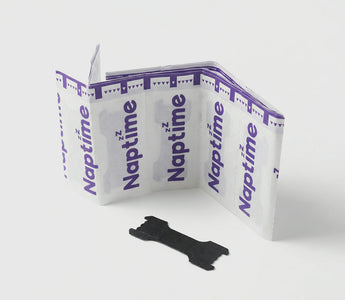
Quick answer: Yes, nasal strips do work, for a specific problem. They mechanically widen the nostrils, which reduces airflow resistance through the nose, and clinical research has consistently shown they reduce snoring caused by nasal congestion or narrow nasal passages. They will not stop snoring caused by sleep apnoea, throat-tissue vibration, or alcohol, and they are not a treatment for any medical condition. If your nose feels blocked when you try to breathe through it with your mouth closed, a nasal strip is likely to help. The Naptime Nasal Strips (30-pack, $28 on sale) are a low-risk way to test whether nasal airflow is your problem.
In this guide:
- How nasal strips work
- What does the research say?
- Who do nasal strips help — and who don't they help?
- How to use nasal strips properly
- Nasal strips vs nasal dilators vs CPAP
- FAQs
How nasal strips work
A nasal strip is a flexible adhesive band that sits across the bridge of the nose and gently pulls the sides of the nostrils outward, widening the nasal valve — the narrowest point of the airway, just inside the nostrils. The band has a built-in spring tension that, when stuck to the skin, exerts an outward pull.
Widening the nasal valve does two things:
- Reduces resistance to airflow through the nose. Less effort to breathe in.
- Reduces turbulence in the airflow, which is what causes the soft tissues at the back of the nose and throat to vibrate (the sound we hear as snoring).
The strip itself is non-medicated. There's no drug. The mechanism is purely mechanical, it's a tiny external splint for your nose.
What does the research say?
Multiple peer-reviewed studies have measured nasal strips' effect on airflow, snoring volume, and perceived sleep quality. The headline findings:
- Nasal airflow. Nasal strips measurably increase the cross-sectional area of the nasal valve and reduce nasal airflow resistance in healthy adults and in adults with mild nasal obstruction. This effect is well-established in rhinology research.
- Snoring. Studies measuring snoring volume and frequency with bed partners as observers have found nasal strips reduce snoring in users whose primary cause is nasal congestion or narrow nasal anatomy. Effect sizes vary, but bed-partner-reported snoring improvement is consistently positive in this group.
- Sleep apnoea. Nasal strips do not treat obstructive sleep apnoea. They may make a person with mild OSA feel slightly less congested, but they don't keep the airway open at the throat — which is where apnoea obstruction happens. If you're regularly stopping breathing in your sleep, you need a sleep study and likely CPAP, not a nasal strip.
- Athletic performance. Studies on exercise performance have found small or no measurable benefit to endurance, despite the popularity of nasal strips among athletes. The marketing claim that they "boost performance" is weakly supported.
The honest summary: if you snore because your nose is blocked or narrow, nasal strips reduce snoring and feel like easier breathing. If you snore for any other reason, they won't help.
Who do nasal strips help — and who don't they help?
Nasal strips likely help if you…
- Snore louder when you have a cold
- Have a noticeably narrow or "pinched" nose
- Mouth-breathe at night despite no medical reason to
- Feel congested at night even when you're not sick (allergies, dust, dry climate)
- Wake up with a dry mouth from mouth-breathing
- Have a deviated septum mild enough to live with
Nasal strips probably won't help if you…
- Have been diagnosed with obstructive sleep apnoea
- Snore loudly even when your nose feels clear
- Snore worse after alcohol (this is throat-tissue vibration, not nasal)
- Snore on your back but not on your side (positional snoring — try a side-sleeper pillow first)
- Have severe nasal blockage from a structural issue — see an ENT
The 2-week test
Use nasal strips every night for two weeks and ask your bed partner whether your snoring is quieter, the same, or louder. If quieter, nasal strips work for you and you've found a $28 fix. If the same or louder, the cause is downstream of your nose and you need a different solution.
How to use nasal strips properly
Most nasal-strip failures are application failures, not product failures. Three steps:
- Clean and dry skin first. Wipe the bridge of your nose with a cleanser to remove oil and moisturiser. Pat dry. The strip's adhesive does not stick to oily or damp skin.
- Place across the widest part of the nose. Position the strip so the centre sits on the bridge of your nose, and the ends extend onto the soft tissue on each side of the nostrils — not down on the cheek and not up on the bone.
- Press firmly for 30 seconds. Especially the ends. This activates the adhesive and ensures the spring tension transfers to the nostrils.
Remove gently in the morning by wetting the strip with warm water in the shower, then peeling slowly from each end toward the centre.
Don't reuse strips — the adhesive only works once, and the spring loses tension after one use.
Nasal strips vs nasal dilators vs CPAP
| Where it works | When to use | Cost | |
|---|---|---|---|
| Nasal strips | External, across the bridge of the nose, pulls nostrils open | Mild nasal congestion, narrow nostrils, allergy-related snoring | $28 for 30 nights (Naptime) |
| Nasal dilators (internal) | Inserted into the nostrils to hold them open | Same use case as strips; some find internal more effective, some find it irritating | $20-40 per pack |
| Saline nasal spray | Internal, clears mucus | Snoring linked to congestion from a cold or allergies | $10-15 per bottle |
| Side-sleeper positional aids | Pillow shape, anti-snore pillows | Positional snoring (only when on back) | $50-150 |
| Mandibular advancement device | Mouthguard that holds jaw forward | Throat-based snoring, mild apnoea | $100-700 (OTC or dentist) |
| CPAP | Pressurised air through a mask, keeps airway open | Diagnosed obstructive sleep apnoea | $1,000-3,000 (medical) |
Start at the top, work down. Nasal strips are the cheapest, most reversible intervention. If they don't help, move to the next option.
Frequently asked questions
Do nasal strips actually stop snoring?
Nasal strips stop or reduce snoring caused by nasal airflow resistance — typically about 30-40% of cases. They don't stop snoring caused by throat-tissue vibration, sleep apnoea, or alcohol. The 2-week test is the fastest way to know if they work for you.
How long do nasal strips last?
Nasal strips are single-use. Apply at bedtime, remove in the morning, throw away. A 30-pack lasts one person one month of nightly use.
Are nasal strips safe to use every night?
For most people, yes. The only common side effect is skin irritation on the bridge of the nose from the adhesive — alternate the position slightly each night, and skip a night if your skin is irritated. People with very sensitive skin or eczema should patch-test on the inside of the forearm first.
Can children use nasal strips?
Nasal strips are made for adults. Children's nasal anatomy is different and the spring tension is calibrated for adult nostrils. If a child snores regularly, see a GP rather than self-treating.
Do nasal strips help with sleep apnoea?
No. Sleep apnoea is caused by airway collapse at the throat, not nasal congestion. Nasal strips don't address that mechanism. If you've been diagnosed with sleep apnoea, follow your CPAP or oral-appliance treatment plan.
Do nasal strips help with athletic performance?
Research is mixed and effect sizes are small. The strongest evidence is for reducing perceived breathing effort, not measurable improvements in VO2 max or endurance. Many athletes use them anyway because the perceived-effort benefit feels real.
What are Naptime Nasal Strips made of?
A flexible, latex-free adhesive band with a built-in spring strip. Hypoallergenic adhesive, no medication. Made for adult nostrils.
Try them tonight
The cheapest, fastest test of whether nasal airflow is your snoring problem:
- Naptime Nasal Strips — 30 pack — $28 on sale (RRP $43). 5.0★. One pack = one month of nightly use.
- Pair with the Sleep Essentials Bundle — view bundle
Related reading
- Best Mattress in Australia 2026: Tested and Compared
- Best Mattress for Couples with Different Firmness Preferences
This article is general information, not medical advice. If you snore loudly, stop breathing during sleep, or feel exhausted despite a full night's sleep, see a GP about a sleep study.