



You replace your pillows. You wash your sheets. But the thing doing all the heavy lifting — the mattress underneath — quietly wears out without telling you. Most Australians sleep on a mattress years past its best, blaming bad sleep on stress, screens or coffee. Here's how long a mattress actually lasts, the signs it's done, and when replacing it is genuinely worth the spend.
How long does a mattress last?
Most mattresses last 7 to 10 years. After that, the materials inside start to break down faster than they support you — foams soften, springs lose tension, and the comfort you bought slowly disappears.
But "7 to 10 years" is an average, not a rule. The real lifespan depends on the type of mattress, how it's built, how much it's used, and how well it's looked after. A quality mattress on a proper base, rotated regularly, can comfortably hit the upper end. A cheap one on a sagging base might be done in four.
How long each mattress type lasts
Not all mattresses age the same way. Here's a realistic guide by type:
- Memory foam: 7–10 years. Higher-density foams hold up longer; cheap low-density foam softens and pits early.
- Pocket spring: 7–10 years. Individually wrapped coils outlast old-style connected innersprings, which tend to sag in the middle by year five or six.
- Hybrid (foam + pocket springs): 8–10 years. The combination spreads the load, so neither layer wears out as fast.
- Latex: 10–12 years. The most durable option, but heavier and pricier.
- Traditional innerspring (older style): 5–7 years. The connected-coil design wears unevenly and dips where you sleep.
If you're weighing up which type suits you before you replace, our pocket spring vs memory foam vs hybrid guide breaks down how each one actually feels and performs.
7 signs you need a new mattress
Age is only half the story. A mattress can be five years old and finished, or eight years old and fine. The clearer signal is how it makes you feel and what it looks like. Watch for these:
1. You wake up sore or stiff
If you go to bed fine and wake up with a sore lower back, achy hips or a stiff neck — and it eases off through the morning — your mattress is the likely culprit. A worn mattress stops supporting your spine in a neutral position, so your body compensates all night.
2. There's a visible sag or dip
Strip the bed and look across the surface at eye level. A body-shaped dip, a sagging middle, or a hammock effect means the support layers have collapsed. Once a mattress has a permanent dip, no amount of flipping fixes it.
3. You sleep better away from home
If you consistently sleep better in a hotel or at a friend's place, that's a strong tell. It's not the new sheets — it's a mattress that still does its job.
4. You can feel the springs
Feeling individual coils, lumps or hard spots through the comfort layer means the padding has compressed and the structure underneath is exposed. It only gets worse from here.
5. It's noisy
Creaking, squeaking or grinding when you move usually means the springs are wearing out or the support core is failing.
6. Your allergies or asthma have crept up
Older mattresses accumulate dust mites, sweat and allergens over years of use. If you're waking congested, sneezy or itchy and can't pin down why, an ageing mattress can be part of it — especially if it's never had a protector on it.
7. You and your partner roll into the middle
If you're both drifting toward a central valley, or one person's movement wakes the other, the mattress has lost its structure and its motion isolation. Worth knowing: this is also one of the most common couples' sleep problems, and a replacement often solves it.
What makes a mattress wear out faster
If your last mattress didn't go the distance, one of these is usually why:
- The wrong base. An unsupportive or sagging base drags the mattress down with it — and on most mattresses, using the wrong base can void the warranty. A solid, slatted base with proper support is non-negotiable. (More on this in our bed base guide.)
- Never rotating it. Sleeping in the same spot every night wears one zone faster than the rest. Rotating head-to-toe spreads the load.
- No mattress protector. Sweat, spills and moisture break down foams and rust springs over time. A protector is the cheapest way to add years.
- Low-density materials. Cheaper mattresses cut corners with low-density foam that softens and sags far sooner than the spec sheet suggests.
How to make your mattress last longer
Whether your current mattress has years left or you're about to buy your next one, these habits stretch its lifespan:
- Rotate it every 3–6 months (head to foot) for even wear.
- Use a mattress protector from day one to block sweat, spills and allergens.
- Put it on a supportive base — and check your warranty terms for base requirements.
- Air it out occasionally by pulling back the sheets to let moisture escape.
- Don't sit on the same edge every day — it breaks down the perimeter support.
When is replacing your mattress actually worth it?
Here's the honest maths. You spend roughly a third of your life on your mattress — that's around 3,000 nights over an eight-year lifespan. Spread the cost of a quality mattress across that and you're paying cents per night for something that affects how you feel every single day.
If you're ticking off two or more of the signs above — waking up sore, a visible sag, sleeping better elsewhere — you've likely already passed the point where a new mattress pays for itself in better sleep, fewer aches and more energy. Patching it with a topper can buy a little time, but it can't rebuild support that's already gone.
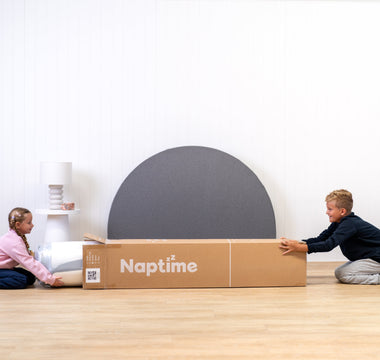
The good news: replacing a mattress no longer means a $3,000 showroom trip. A quality mattress in a box delivered to your door does the same job for a fraction of the price. If you're not sure which one suits how you sleep, the Naptime Mattress Quiz matches you in a couple of minutes — and every Naptime comes with a 100-Night Goodnight Guarantee, so you can be sure it's right before you commit.
Frequently asked questions
How often should you replace a mattress?
Every 7 to 10 years for most mattresses. Replace sooner if you're waking up sore, you can see a sag or dip, or you consistently sleep better away from home — those signs matter more than the calendar.
How long does a memory foam mattress last?
A quality memory foam mattress lasts 7–10 years. Higher-density foam lasts longer; low-density budget foam softens and develops body impressions much sooner.
Does a mattress topper extend the life of a mattress?
A topper can refresh comfort and buy some time, but it can't restore lost support. If your mattress has a structural sag or you're waking up sore, a topper masks the symptom rather than fixing the cause.
Can a sagging mattress cause back pain?
Yes. When a mattress sags, it stops holding your spine in a neutral position, which puts strain on your lower back, hips and shoulders overnight. Waking up stiff or sore that eases through the day is a classic sign.
How long should a mattress last if you look after it?
Looked after well — rotated regularly, on a supportive base, with a protector — a quality pocket spring, hybrid or memory foam mattress comfortably reaches the upper end of 7–10 years, and latex can last 10–12.
Is it worth replacing a mattress that's still comfortable?
If it's genuinely still supportive and you wake up rested, no rush. But "comfortable" and "supportive" aren't the same — a mattress can feel soft and cosy while no longer holding your spine properly. Use the 7 signs above rather than comfort alone.